Find It Out® - Hidden Object
- 4.9
- Rating
- 10.00M
- Installs
- Free
- Price

 Analysis by App-foxy
I approached Find It Out® - Hidden Object as the sort of puzzle game you open when you want a focused break rather than a long, complicated campaign. It is built around searching illustrated scenes for concealed objects, unlocking maps as you progress, and gradually improving your ability to notice small visual details. That sounds simple, but the quality of a hidden-object game depends heavily on how fair the scenes feel, how readable the targets are, and whether the search remains relaxing instead of becoming a test of patience.
After spending time with it, my view is that this is a strong choice for players who enjoy quiet observation, short sessions, and the satisfaction of completing a visual checklist. It is free to start, suitable for Everyone, and available for Android users on version 7.0 or later. Guru Puzzle Game has clearly aimed at broad accessibility rather than a niche audience, and the result is easy to understand within moments. The important question is not whether the basic idea works; it does. The better question is whether this particular style of puzzle matches the way you like to play.
How to decide whether this hidden-object game fits you
I use this section to weigh whether the game’s simple search loop is likely to stay enjoyable once the first few maps feel familiar. The key is not how quickly you clear a scene, but whether you like returning to a picture and noticing details you missed before. With that preference in mind, it becomes easier to judge how much lasting value the game may offer.
You May Also Like

 Blood Strike: 2.5 Anniversary
Blood Strike’s Loadouts Turn Every Drop Into a Tactical Gamble
A close look at Blood Strike’s custom loadouts: how fast access to signature weapons reshapes its battle royale rhythm, rewards preparation, and narrows the gap between fights.

 Pandora - Music & Podcasts
Pandora’s Music Is Easy to Start, but Harder to Recover
Pandora’s strength is its low-effort path from a seed to a station. Its weak spot is how much confidence it asks you to place in connection, setup, and quiet recovery.

 8 Ball Pool
 Is Built on Rivalries, Rematches, and Routine
A close look at the rivalries, rematches, shared routines, and unanswered safety questions that turn a quick pool match into a persistent mobile community.

 Samsung Music
’s Quiet Strength Is Playing What You Already Own
Its reach comes less from spectacle than from dependable access to a personal library. That simplicity is both the app’s strongest retention engine and its ceiling.

 AccuWeather: Weather Radar
AccuWeather Review: A Quick, Clear Forecast for Everyday Decisions
For everyday plans, the best forecast is the one you can understand quickly. AccuWeather makes rain timing, radar, and local conditions easy to act on, with a few trade-offs.

 Hill Climb Racing
Why Hill Climb Racing Still Turns Crashes Into One More Run
A tiny car, a bumpy hill and one more upgrade: Hill Climb Racing keeps resurfacing because its simple chaos makes every near-miss feel personal.
More From Our News Desk



The right kind of challenge for your spare time
The first decision criterion is pace. This is not a game I would choose when I want fast reactions, strategic combat, or a story that constantly pushes me forward. Its appeal comes from scanning a scene, recognizing shapes, and remembering what still needs to be found. I can play for a few minutes, stop, and return without having to reconstruct a complicated plot or remember a chain of objectives.
That makes it particularly suitable for small gaps in the day. Imagine waiting for an appointment with only ten minutes available. A map gives you a contained task, and the act of searching gives those minutes a clear focus. I find that more satisfying than endlessly scrolling through short videos, because each completed search leaves me with a visible sense of progress.
The game also suits players who like visual puzzles but do not necessarily want mathematics, wordplay, or time pressure. If you normally enjoy “spot the difference” activities, seek-and-find books, or relaxing picture puzzles, the central loop should feel natural. The experience asks you to look carefully rather than memorize rules, build a character, or manage resources.
What the core loop feels like in practice
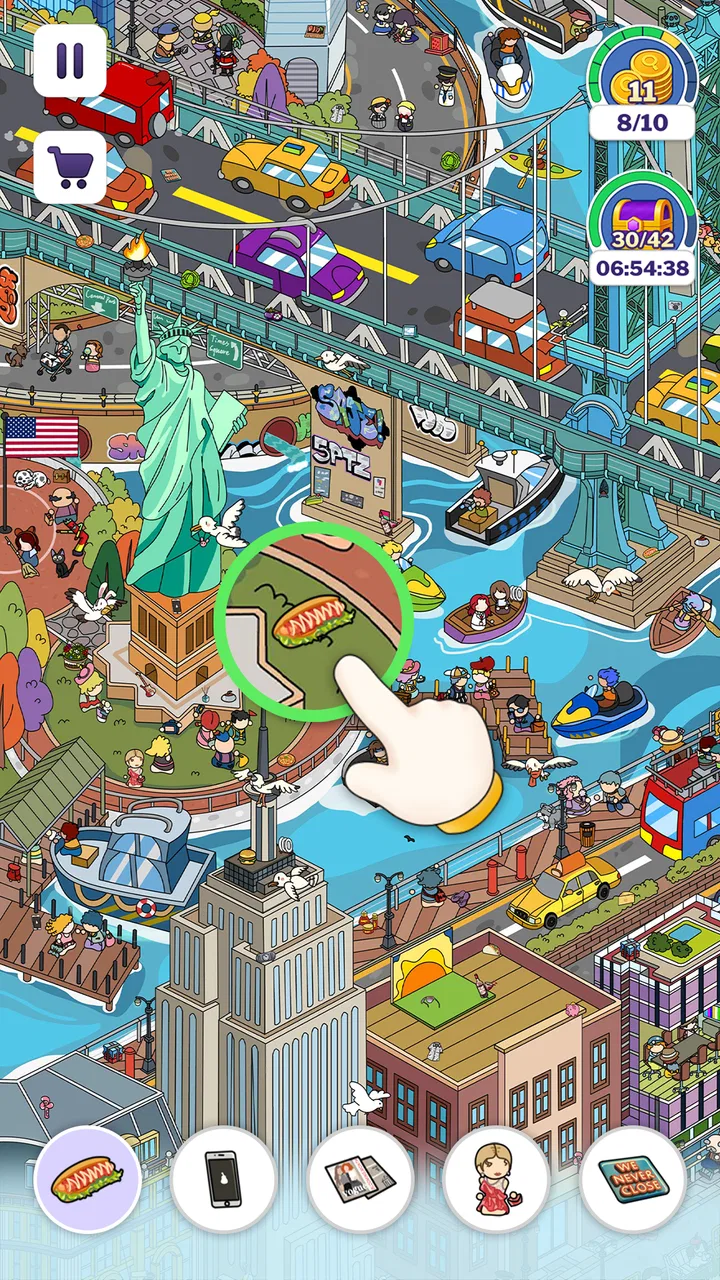
A typical session starts with a scene filled with details. You examine the image and search for the objects requested by the game. Some items stand out quickly, while others blend into the surroundings through color, scale, or placement. The pleasure comes from the small moment when a previously overlooked object suddenly becomes obvious.
I recommend resisting the urge to sweep randomly across the screen. A better method is to divide the scene into zones: upper corners, edges, central objects, and areas with similar colors. I usually scan from left to right, then check the background behind larger items. This approach is more reliable than tapping everywhere, and it makes difficult maps feel like an observation exercise rather than a guessing game.
One useful habit is to identify the visual category of the target before searching for its exact shape. If the request is for something round, metallic, leafy, or colorful, I first look for that characteristic. This is especially helpful in busy scenes where the object is partially hidden. The game rewards patience, but it also rewards a systematic search pattern.
Why its broad audience matters
The Everyone content rating makes the game approachable for families and younger players, while the straightforward controls mean that a new player does not need a tutorial-heavy introduction. I could hand it to someone unfamiliar with mobile games and explain the objective almost immediately: inspect the picture and locate what is hidden.
That simplicity is a genuine strength, but it also defines the limits of the experience. Players who need a deep progression system may find the premise too narrow. There is no reason to expect this to replace a complex logic game or a narrative adventure. It is best viewed as a focused visual pastime, not an all-purpose puzzle platform.
Where it stands out among puzzle alternatives
Compared with match-three games, the main attraction here is concentration rather than rapid repetition. Match-three titles often ask you to plan combinations under changing board conditions. This game asks you to slow down and inspect. I prefer it when I want my attention directed toward one image instead of several moving elements.
Compared with crossword or word-search games, it offers a more visual route into puzzle solving. There is no need to know specific vocabulary or maintain a large mental word bank. That can make it a better choice for a mixed-age household or for someone playing in a language they are still learning. The trade-off is that a player who loves language-based deduction may find the scenes less intellectually varied.
Compared with traditional hidden-object adventures, the attraction is the lower commitment. I can focus on a map without feeling that I must follow a long story or remember a sequence of characters. On the other hand, players who enjoy narrative clues, elaborate mysteries, or object-combination puzzles may prefer a story-driven alternative. This game’s satisfaction is immediate and visual, not dramatic.
Where the game wins for me
The strongest part of Find It Out® - Hidden Object is its clean, understandable purpose. The game does not need a complicated explanation to become enjoyable. I can start searching almost at once, and the map-based structure gives the activity a sense of direction without making it feel like work.
Another advantage is the way the format supports different attention levels. On an easy scene, I can play casually while taking a break. On a busier scene, I can settle in and concentrate more seriously. That flexibility is more valuable than it may sound. Many puzzle games are either so passive that I lose interest or so demanding that I avoid opening them. This one occupies a comfortable middle ground.
The visual search format also creates a useful offline-style mental routine, even though I would not assume every gameplay condition without checking the current app behavior on a particular device. My practical advice is to treat each map as a small observation session: look broadly first, then inspect clusters of detail, and only use assistance when you have genuinely narrowed the search. That preserves the satisfaction of finding objects yourself.
Three techniques that make difficult scenes less frustrating
First, I keep track of the objects I have already checked by mentally assigning them to areas of the picture. When a scene is crowded, repeatedly revisiting the same corner wastes time and can make the game feel harder than it is. A clockwise sweep around the border followed by a pass through the center gives me a consistent workflow.
Second, I look for interruptions in visual patterns. A repeated row of boxes, leaves, windows, or decorations may hide one item that does not quite match. Instead of searching only for the object’s literal outline, I watch for something that breaks the rhythm of the background. This is one of the most effective ways to find targets that have been blended into the artwork.
Third, I change my zoom and viewing distance when the screen allows it to be useful. An object that is difficult to recognize when the whole scene is visible can become easier when I examine one section closely, while a zoomed-in view can make it harder to understand where that section sits in the overall composition. Alternating between a broad view and a close inspection prevents tunnel vision.
These methods are not flashy features, but they change the experience. They turn searching into a repeatable skill, which is why I think the game works better for attentive players than for people who simply tap until something responds.
The friction you should expect
The same visual density that makes a map rewarding can also make it tiring. After several challenging scenes, I sometimes notice that I am no longer carefully observing; I am just scanning every inch with growing impatience. This is a sign to pause rather than force the session. The game is relaxing when I control the pace, but it can become repetitive if I treat it like a task to clear as quickly as possible.
There is also a natural limit to replay value in this type of puzzle. Once I know where an object is, the discovery is no longer fresh. Unlocking further maps helps maintain forward movement, but the central action remains searching through pictures. Players who need constantly changing mechanics may eventually want a different puzzle category.
Because the game is free, I would also pay attention to the way optional purchases fit your personal habits. In-app purchases range from $0.99 to $99.99 per item. I would not spend simply because a scene is taking longer than expected. My preferred approach is to use the game’s challenge as the point of playing and consider any optional purchase only after deciding whether the overall experience has earned that extra commitment.
When another category is a better fit
I would steer you toward a logic game if you want every move to have a clearly measurable chain of consequences. A Sudoku-style puzzle, for example, is built around deduction and constraint, while this game is built around recognition and attention. Neither approach is automatically better; they exercise different kinds of thinking.
I would choose a word puzzle instead if you enjoy building answers from clues or expanding your vocabulary. I would choose a match-three game if you want quick rounds with colorful movement and more immediate feedback. I would choose a story-led adventure if your main reason for playing is character development or mystery solving.
There is also a practical consideration for players with visual fatigue or difficulty distinguishing small details. A hidden-object game can be less comfortable than a text-based or large-format puzzle, especially in crowded scenes. Before committing to long sessions, I would test how readable the artwork feels on your phone and whether the interface lets you inspect details comfortably. The Everyone rating describes the broad content suitability, not a guarantee that the visual demands will suit every player.
What switching from another puzzle game involves
The cost of switching to this game is low in terms of learning. If you already play mobile puzzles, you will understand the basic interaction immediately. You do not need to learn a complex control scheme, remember a large set of rules, or study a tutorial before making progress.
The bigger adjustment is psychological. Players coming from competitive or timed games may initially feel that the pace is too quiet. There is less excitement from beating an opponent or surviving a difficult round. In return, the game gives you room to inspect, pause, and continue at your own rhythm. I found that it works best when I stop measuring success by speed and instead focus on completing a careful search.
Switching also means accepting that progress depends on visual persistence. If you are accustomed to solving a puzzle through a single clever insight, some scenes here may feel more like sustained attention. That is not a flaw, but it is an important difference. The game rewards the player who is willing to revisit an overlooked area and notice a small detail.
For families, the transition can be especially easy because the objective is simple enough to explain aloud. One person can search the left side while another checks the right, turning a solitary puzzle into a cooperative conversation even though the game itself remains a single-screen search. I would use that approach with younger players who become frustrated: share a method, not the answer, and let them make the final discovery.
Who should install it
I think this is a good match for casual puzzle fans, visual thinkers, families looking for a simple shared activity, and anyone who wants a calm game for short breaks. It is also a sensible option if you prefer games that can be understood without a long introduction. The free entry point makes it easy to test whether the searching style clicks with you before considering any optional spending.
The game’s scale is reflected in its audience: it has passed 10 million installs, carries a 4.9 average from around 359 thousand ratings, and has about 6.8 thousand written reviews. Those figures do not decide whether you personally will enjoy it, but they do suggest that the hidden-object format has connected with a large number of players.
Guru Puzzle Game has kept the identity focused on finding and unlocking rather than adding unrelated systems. The current version is 3.71.0, so I would keep the app updated through the normal store process to receive the version available for your device. Since the minimum operating system is Android 7.0, owners of older phones should check compatibility before planning around it.
My recommendation after weighing the trade-offs
I recommend Find It Out® - Hidden Object if you want a free puzzle game centered on observation, with map progression and enough visual variety to make short sessions worthwhile. Its best quality is not complexity; it is the ease with which it gives your attention a clear job. I can open it, search a scene, finish a small objective, and leave without feeling that I have abandoned a larger commitment.
I would skip it if you need fast action, deep strategy, competitive pressure, or a strong narrative. I would also avoid treating it as an endless source of novelty. The central pleasure is the search itself, and that pleasure depends on enjoying careful visual inspection. If that sounds satisfying rather than repetitive, this is one of the more approachable puzzle choices to try.
My final advice is to give it a fair trial using a deliberate search method instead of rushing through the first map. Start with broad sections, notice breaks in patterns, and take a pause when your eyes become tired. If you finish a session feeling pleasantly focused, the game is doing exactly what it is designed to do. If you feel only impatience, another puzzle category will probably serve you better.
For me, the balance is favorable: accessible controls, a clear visual goal, a free starting point, and enough structure to make each map feel like a small accomplishment. The limitations are real, especially the repetitive foundation and the possibility of visual fatigue, but they are easy to understand before spending money. I would recommend trying it for calm, detail-oriented play rather than expecting a full adventure. Within that role, it is a polished and genuinely enjoyable choice.
FAQs for Find It Out® - Hidden Object
01What is Find It Out® - Hidden Object?
Find It Out® - Hidden Object is an engaging puzzle game available for both Android and iOS platforms. The game challenges players to locate hidden objects within intricate scenes. Each level presents a new set of items to find, testing your observation skills and attention to detail, making it ideal for casual gamers looking for a fun and relaxing experience.
02Is Find It Out® - Hidden Object free to play?
Yes, Find It Out® - Hidden Object is free to download and play. However, it does offer in-app purchases that can enhance the gaming experience. These purchases might include hints, additional levels, or ad-free gameplay options. Players can enjoy the game without spending money, but these extras can offer added convenience.
03What are the key features of Find It Out® - Hidden Object?
The game boasts a variety of features that enhance the player experience. It includes beautifully crafted scenes, a wide range of objects to find, and increasing levels of difficulty. Additionally, the game offers hints for challenging levels, a user-friendly interface, and regular updates that introduce new content and themes, keeping the gameplay fresh and engaging.
04Can I play Find It Out® - Hidden Object offline?
Yes, Find It Out® - Hidden Object can be played offline, allowing you to enjoy the game without an internet connection. This makes it perfect for passing the time while traveling or in areas with limited connectivity. However, certain features, like in-app purchases and updates, require an internet connection.
05Is Find It Out® - Hidden Object suitable for all ages?
Find It Out® - Hidden Object is designed to be family-friendly and suitable for players of all ages. Its simple yet challenging gameplay appeals to both younger and older audiences, making it a great choice for family entertainment. Parents can feel confident allowing their children to play, as it encourages cognitive development and observation skills.
Pros
- Engaging puzzles that challenge observation skills.
- Vibrant graphics enhance the gameplay experience.
- Frequent updates with new levels and themes.
- Intuitive interface makes navigation easy.
- Offline mode available for uninterrupted play.
Cons
- In-app purchases can be quite expensive.
- Some levels may feel repetitive over time.
- Occasional ads disrupt gameplay flow.
- Requires a lot of storage space on device.
- Limited hints can be frustrating for beginners.

Find It Out® - Hidden Object
Gallery